
Fiberglass and FRP Tanks for Fish Farming: Geometry, Drains, Transport, and Viewing Windows
How to specify molded FRP fish farming tanks, dual-drain plumbing, hauling units, and fiberglass tank with window options without leak points.
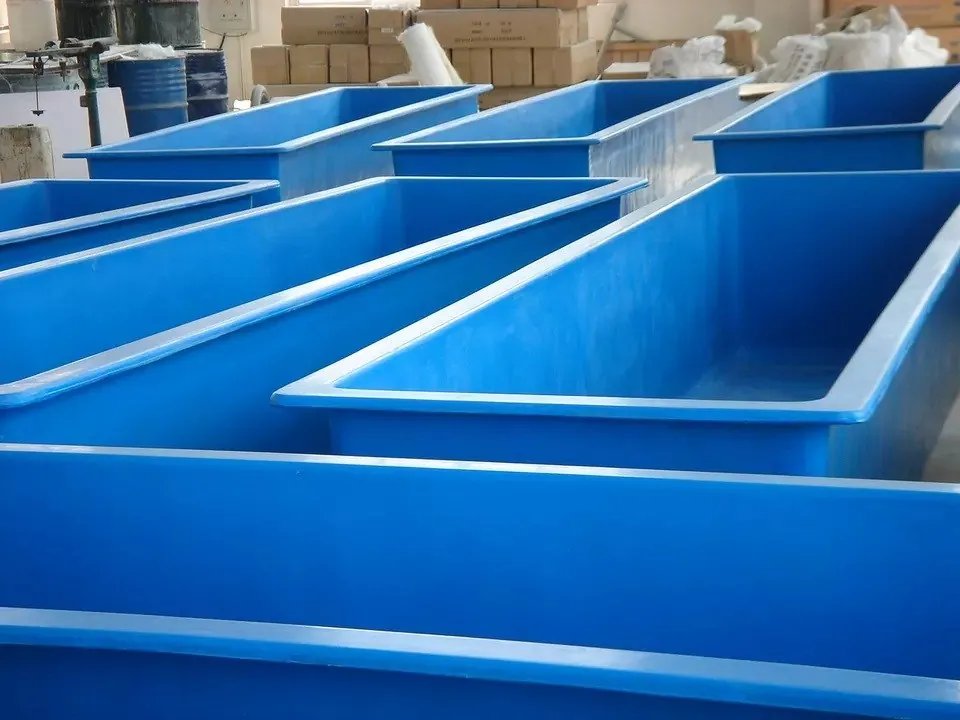
Rigid molded FRP fish tanks cost more per cubic meter to fabricate and ship than collapsible liner assemblies, yet hatcheries, quarantine rooms, and intensive indoor farms specify them wherever flexible walls fall short. Fiberglass-reinforced plastic (FRP, also written GRP on export tenders) cures into a self-supporting shell with a smooth, food-grade gel-coat interior. Across commercial aquaculture tanks, fiberglass fish farming tanks justify their upfront capital where fast sanitary turnaround, molded-in drain sumps, low algae adhesion, and multi-decade service in freshwater or saltwater outweigh flat-pack freight savings.
Round, Rectangular, and D-End Geometry: Hydraulic Trade-Offs
Shell geometry governs both floor-space efficiency and solids self-cleaning. Tangential inlet jets in a round vessel drive rotational flow that sweeps feces and uneaten pellets inward toward the center drain. By contrast, rectangular fiberglass tanks sit flush against building walls and walkways, capturing indoor floor area that circular footprints leave unused. Long fiberglass raceway tanks and D-end channels trade rotational swirl for directional plug flow, allowing operators to crowd, grade, and harvest fish cleanly with a full-width screen.
Structural mechanics set the laminate cost behind that hydraulic choice. A cylindrical wall carries water pressure in uniform hoop tension, which glass rovings handle without external framing. Flat side walls carry hydrostatic head in bending and bow outward when filled unless molded with perimeter rim flanges and external reinforcing ribs. The same stiffening rule applies to the shallow fiberglass troughs aquaculture nurseries use for egg incubation, fry sorting, and short bath treatments.

Standard Indicative Sizes and Custom Molded Configurations
When an indoor nursery orders a rigid fiber tank for fish farming, shells are molded to project specifications around standard round mandrels or custom flat-panel molds. Specifying a custom fiberglass tank lets the engineer lock in diameter, wall height, gel-coat color, and drain orientation before lay-up starts. At the smallest scale, a ~500 L round unit works alongside conical larval vessels and an artemia tank in hatchery live-feed and fry rooms where smooth interior radii must wipe clean between batches.
| Model | Indicative Capacity & Dimensions | Primary Duty | Configuration | | SIGMA-FRP-1 | ~500 L (Ø1.0 × 0.7 m) | Fry / research | Round | | SIGMA-FRP-2 | ~3,000 L (Ø2.0 × 1.0 m) | Holding / nursery | Round | | SIGMA-FRP-3 | ~8,000 L (Ø3.0 × 1.2 m) | Intensive indoor grow-out | Round | | SIGMA-FRP-4 | ~16,000 L (Ø4.0 × 1.3 m) | Intensive indoor grow-out | Round | | SIGMA-FRP-R | Per order (L × W × H) | Custom rectangular / D-end | Rectangular / D-end | | SIGMA-FRP-W | Per order | With viewing window | Round / rectangular + window |
Ocean freight shapes sizing decisions early. Smaller tapered shells nest inside one another to cut shipping volume, whereas large fiberglass fish tanks hit standard ocean container door limits once molded in one piece. Above container-door width, farms either split production biomass across multiple container-compatible round or D-end units, or weigh oversized freight against knock-down liner tanks.

Specifying Fiberglass Tank with Window Options Without Creating Leak Points
Ordering a fiberglass fish tank with viewing window panels earns its molding cost where side-profile visibility changes daily husbandry: broodstock conditioning and spawning checks, subsurface feeding-response checks, quarantine gill observation, research trials, and live-sales display. Along bulk indoor grow-out rows, windows rarely pay back because top-down inspection is sufficient and every pane adds routine interior algae-wiping labor.
Cutting an opening into a cured shell after demolding invites chronic seepage. A field cutout breaks continuous hoop tension in a round wall and severs rib continuity in a flat panel, concentrating stress at the aperture corners. In proper FRP fabrication, a fiberglass tank with window framing has its opening reinforced during lay-up with local stiffening ribs and a molded seating flange rather than relying on post-cure cutouts, with window dimensions and sealing details confirmed per project.
Drainage Plumbing: Central, Side, and Cornell-Type Dual Drains
Smooth gel-coat walls only protect water quality if settleable waste exits before turbulence breaks pellets and feces into fine suspended solids. Molded bottoms integrate sloped sumps without liner folds that trap sludge, which helps in intensive nurseries and biofloc fish farming units where daily solids draw-off stabilizes dissolved oxygen.
- Central bottom drain with overflow standpipe: Standard on round vessels, using rotational bottom currents to sweep settleable solids to a center sump controlled by an internal sleeve or external standpipe.
- Side-wall drain: Fitted on shallow troughs, raceways, and truck washout sumps where under-slab pipe clearance is absent or directional flow pushes waste to one end.
- Cornell-type dual-drain plumbing: Separates a low-flow bottom center drain for concentrated settleable solids from a raised side or standpipe outlet handling cleaner mid-column water.
Live-Fish Hauling and Holding Tanks: What Changes on a Truck Bed
Truck-mounted fiberglass fish hauling tanks face braking and cornering surge loads that stationary floor shells never experience. Transport-tank versions combine external reinforcing ribs and project-configured top openings with a one-piece food-grade gel-coat bore that prevents scale loss, fin splitting, and mucus abrasion when crowded fish rub the walls in transit.
Optional insulated wall construction slows water temperature drift on long hauls across hot or cold routes. At grading depots or live-seafood markets, fish transfer into shore-side fiberglass fish holding tanks often paired with dissolved oxygen cones for high-density purging and pre-sale staging.
FRP vs PVC Tarpaulin vs HDPE Liner Tanks: Cost and Price Drivers
Selecting between molded FRP, collapsible PVC tarpaulin fish tanks, and bolted HDPE liner fish tanks hinges on freight distance and facility permanence. Flexible liner tanks ship flat on compact pallets and assemble fast on outdoor pads for low-cost grow-out volume. Molded FRP costs more upfront and ships by cubic volume unless nested, paying back in permanent hatcheries, quarantine rooms, and holding depots through rigid self-supporting walls, zero liner replacement, fast disinfection, and decades of service in freshwater or seawater.
On an export quotation, fiberglass fish tank price tracks laminate surface area, wall height, reinforcing rib framing, drain fittings, optional insulation or window tooling, and container nesting efficiency rather than nominal volume alone. Taller walls raise hydrostatic bending loads rapidly, requiring heavier lay-up schedules than wider, shallower shells of equal capacity.
What to Check on Used Fiberglass Aquaculture Tanks Before Buying
Buyers occasionally inspect used fiberglass aquaculture tanks from closed hatcheries to cut initial capital, which only works when the interior gel-coat barrier remains intact. Check four failure points before paying transport:
- Gel-coat crazing and cracks: Spider cracks let water and bacteria wick into the glass laminate beyond the reach of surface disinfectants.
- UV chalking and brittle rims: Prolonged outdoor UV exposure degrades unprotected resin, leaving top flanges prone to cracking during rigging.
- Delaminated reinforcing ribs: Forklift hits or uneven slabs often break the bond between external stiffener ribs or drain collars and the shell.
- Exposed glass fibers in worn sumps: Scoured interiors abrade fish mucus and harbor stubborn biofilm between production cycles.
Frequently asked questions
When is a viewing window worth adding to an FRP fish farming tank?
A viewing window pays off on broodstock tanks, quarantine units, feeding-trial vessels, and live-sales displays where seeing fish posture, gill movement, and mid-column pellet intake guides daily management. On standard indoor grow-out rows, skipping the window lowers unit cost and avoids routine interior pane wiping.
Why do rectangular FRP tanks need external reinforcing ribs while round tanks often do not?
Round shells carry internal water pressure evenly in hoop tension around the circumference. Flat rectangular walls carry hydrostatic pressure in outward bending and will bow or crack at corners unless stiffened with perimeter rim flanges and molded external reinforcing ribs.
How does a Cornell-type dual drain improve solids removal in intensive FRP tanks?
A Cornell-type dual drain splits discharge into two streams: rotational bottom flow sweeps heavy feces and uneaten feed into a low-flow bottom center drain, while cleaner mid-column water exits through a raised side outlet or standpipe.
Can a standard hatchery FRP tank be strapped onto a truck for live-fish transport?
Stationary floor tanks are not built for road surge loads. Purpose-molded FRP hauling versions keep the same smooth, non-abrasive gel-coat interior to protect fish scales and mucus, while adding external reinforcing ribs, optional wall insulation, and project-specific outlet and cover layouts.
What project details are needed to quote a molded-to-order FRP aquaculture tank?
An accurate quotation requires target volume or internal dimensions, shape such as round, rectangular, or D-end, wall height, freshwater or saltwater duty, drain configuration such as central, side, or Cornell dual-drain, and options including viewing windows, insulation, or container-nested sizing.
Put this into practice on your farm
Tell our engineers your species, target density and site — we will size the system and reply within one business day.
More to explore
- What Is Biofloc Technology and How Does It Work?
- Fish Feed Types: Floating vs Sinking Pellets for Aquaculture
- Trichodina in Tilapia: Symptoms, Diagnosis & Control
- White Spot Disease in Shrimp (WSSV): Prevention & Biosecurity
- Bacterial & Fungal Diseases in Sturgeon: Symptoms & Control
- Columnaris and Parasitic Diseases in Catfish
- Water Quality & Fish Disease: Why Most Outbreaks Start in the Water
Building a system from what you read here? Ask our engineers for a tailored plan →