Shrimp Farming Mistakes & a Biosecurity Guide That Works
The diseases that wipe out shrimp ponds and the mistakes behind them — non-SPF seed, untreated water, low oxygen — plus the biosecurity that prevents them.
Shrimp farming punishes mistakes faster than almost any other kind of aquaculture. A pond of Penaeus vannamei can go from healthy to a total loss in under a week, and once a serious disease is in the water there is usually no treatment that brings the crop back. That single fact reshapes the whole job: you don’t farm shrimp by curing disease, you farm them by keeping disease out. Biosecurity is not a precaution on a shrimp farm — it is the production system.
We supply biosecurity and water-treatment equipment to vannamei farms in Ecuador, Indonesia, Vietnam and Thailand, and the same losses come up in the photos customers send us after every bad cycle: pale shrunken hepatopancreas, white spots on the shell, white strings of faeces floating on the surface, stunted shrimp that never reached size. This guide does two things. Part A is a fast field reference to the diseases that actually empty shrimp ponds. Part B is the part that saves money — the everyday management mistakes that let those diseases in, and the fix for each, equipment included.
Part A — The shrimp diseases that wipe out ponds, at a glance
Most of the damage in shrimp farming comes from a short list of pathogens: a few viruses, a few Vibrio bacteria, one microsporidian parasite, and the white-feces complex that sits on top of them. None of them have a reliable cure once the pond is infected. Here is how to recognise each one.
Viral diseases — no cure, keep them out
White spot disease (WSSV) — the most destructive pathogen in shrimp farming. White spot syndrome virus kills across the whole cycle, with up to 100% mortality in 3–10 days. The sign that names it is white, round spots 0.5–2 mm across embedded in the inside of the shell, usually alongside a reddish body and a sudden stop in feeding. It rides in on infected post-larvae, on intake water, and on carriers like crabs and birds. → Full guide: white spot disease in shrimp.
Infectious myonecrosis (IMNV) — a virus that turns the tail and abdominal muscle opaque white, sometimes reddening at the edges like cooked shrimp, followed by chronic mortality that climbs after stress (a sudden salinity or temperature swing). First reported in Brazil and now established across parts of Southeast Asia, it spreads horizontally through water and cannibalism and has no treatment.
IHHNV (infectious hypodermal and haematopoietic necrosis virus) — rarely kills vannamei outright, but it stunts and deforms them: a bent or deformed rostrum, rough cuticle and uneven, undersized harvests, a syndrome called runt-deformity. The damage is the lost growth, and the defence is the same as for the others — clean, screened seed.
Bacterial diseases — Vibrio and AHPND
AHPND / EMS (early mortality syndrome) — a bacterial disease caused by toxic strains of Vibrio parahaemolyticus carrying the PirAB toxin, which destroys the hepatopancreas and kills up to 100% within the first 30–35 days after stocking. The field picture is mass deaths on the pond bottom, a pale, shrunken hepatopancreas and an empty gut. It is the disease farmers know as the silent die-off. → Full guide: AHPND / EMS in shrimp.
Vibriosis (luminous and red-body disease) — the broader Vibrio problem behind much of the everyday mortality. Vibrio harveyi, V. parahaemolyticus, V. campbellii and relatives live in every pond and turn deadly when the bacterial load climbs and the shrimp are stressed. Signs include a reddened body and tail, lethargy, empty gut, and — with luminous vibriosis — larvae and shrimp that literally glow blue-green in the dark. Vibriosis is the disease most directly driven by water quality and pond-bottom hygiene, which makes it the most preventable. → Full guide: vibriosis in shrimp.
Parasitic disease — EHP
EHP (Enterocytozoon hepatopenaei) — a microsporidian parasite of the hepatopancreas that rarely kills directly. Instead it causes slow growth and stunting: a pond stocked evenly that grows into a wide, ragged spread of sizes, eating feed without putting on weight. EHP also weakens shrimp so that AHPND and white feces hit harder. It is confirmed by PCR, spreads through faeces, cannibalism and contaminated water, and is brutally persistent once it is in a system. → Full guide: EHP in shrimp.
White feces syndrome (WFS)
White feces syndrome — not one pathogen but a complex, recognised by the white, floating strings of faeces on the pond surface that give it its name, plus reduced feeding, a loose pale hepatopancreas and slow growth. It is strongly linked to EHP, Vibrio and a degraded pond bottom, and it is one of the clearest signals that the gut and the bottom have gone wrong. Treated as a warning rather than a single disease, WFS points straight back at management. → Full guide: white feces syndrome in shrimp.
Read down that list and a pattern jumps out. The viruses and EHP are brought in — on seed, on water, on carriers. The bacterial and white-feces problems bloom when the water, the bottom and the shrimp’s stress level go wrong. Both halves are decided by management, which is the whole point of Part B.
Part B — The shrimp farming mistakes that let disease in
After enough farm visits the conclusion is hard to avoid: in most outbreaks the pathogen did not cause the loss — the routine did. Below are the mistakes we see most often, each one paired with the correct practice and the equipment that makes it possible.
Mistake 1 — Stocking non-SPF seed you never PCR-tested
This is the single biggest one, because it decides the crop on day one. Cheap post-larvae from an unscreened hatchery are how WSSV, AHPND, IHHNV and EHP actually arrive on a clean farm — you stock the disease, you don’t catch it. A pond seeded with a carrier batch is lost before the first feed.
Do this instead: stock specific-pathogen-free (SPF) post-larvae from a hatchery you trust, and PCR-test every batch for the pathogens that matter (WSSV, AHPND’s pirA/pirB genes, EHP) before they go in the water. The cost of the test is nothing next to the cost of a lost cycle.
Mistake 2 — Pumping intake water in without disinfecting or filtering
The water is the second highway for every shrimp pathogen. Pumping straight from a shared estuary or canal brings in free virus, Vibrio, and live carriers — crab larvae, copepods, polychaetes, infected wild shrimp — directly into the pond.
Do this instead: treat every drop before it reaches the shrimp. Inactivate free WSSV and vibrios with a UV water sterilizer, and screen out carriers, organic debris and suspended solids with an automatic rotary drum filter backed by a biological filter. Where you can, hold and disinfect intake water in a reservoir rather than pumping straight from the source. Physical screening plus UV is the core of a biosecure intake, and it is the upgrade most often missing on farms that get hit.
Mistake 3 — Overfeeding and wrecking the pond bottom
Feed the shrimp don’t eat doesn’t vanish — it rots on the bottom, drives ammonia and nitrite up, strips oxygen out, and becomes the exact organic load that Vibrio and the white-feces complex feed on. A black, sour pond bottom is a Vibrio factory, and AHPND-causing vibrios bloom on accumulated sludge.
Do this instead: feed to the feed tray, not to a fixed number — give what the shrimp clear, watch the response, and back off the moment they slow. Remove sludge between cycles, dry and lime the bottom. Strip suspended solids continuously during grow-out with the same rotary drum filter, and out-compete the pathogens by building a stable microbial community with probiotics for aquaculture rather than dosing antibiotics into a dirty pond. Use a clean, well-managed shrimp feed and don’t over-deliver it.
Mistake 4 — Leaving dissolved oxygen to the weather
More shrimp die from low dissolved oxygen than from any single pathogen, and low oxygen is also what tips a quiet Vibrio colonisation into a wipe-out. The danger window is the dawn minimum, when DO bottoms out at the pond bottom — exactly where the shrimp and the vibrios live. Relying on wind to oxygenate a stocked pond means the shrimp are most stressed at the worst possible time.
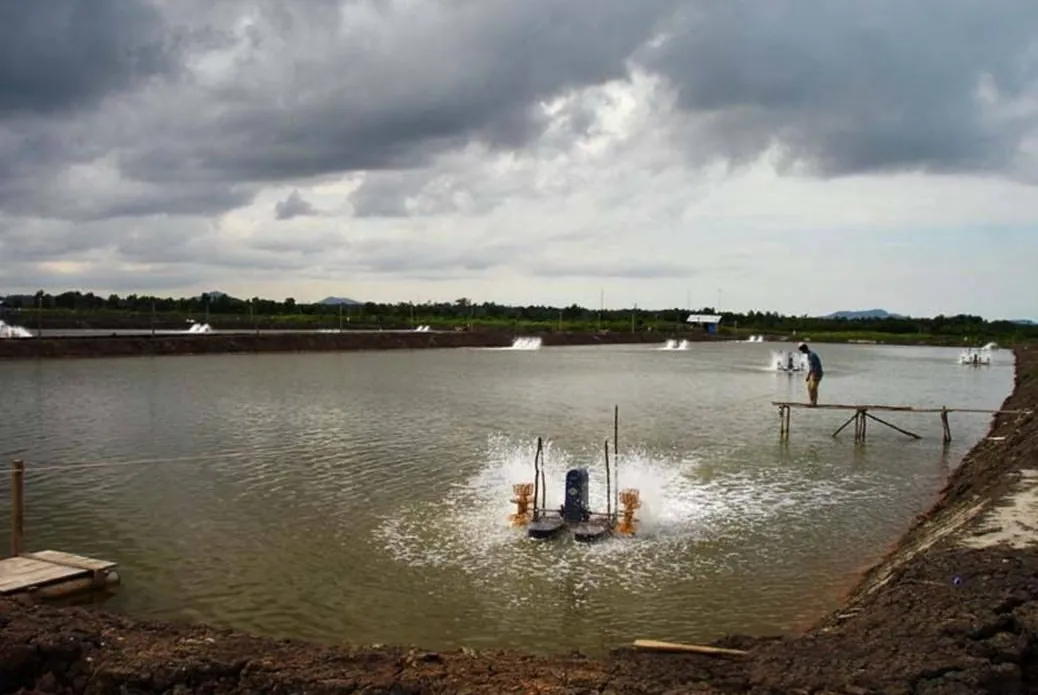
Do this instead: hold dissolved oxygen above 4–5 mg/L day and night, and watch the dawn reading, not the afternoon one. Use a paddle wheel aerator for surface mixing and circulation, and a dissolved oxygen cone where you need high-efficiency oxygen transfer at depth. Add aeration capacity before you add shrimp, never after the first dawn crash.
Mistake 5 — Farming blind, without testing the water
“The shrimp look fine” is not a measurement. Ammonia, nitrite, low DO, a swinging pH or salinity can all be lethal — or can be quietly building the conditions vibrios thrive in — long before the shrimp show it. Farmers who only test after deaths start are always a step behind the pond.
Do this instead: monitor dissolved oxygen, salinity, pH, temperature, ammonia and nitrite on a schedule, not just in a crisis, with a multi-parameter water quality meter. Rising ammonia and a sliding DO are the early signature of an outbreak; you can only act on a trend you can actually see.
Mistake 6 — Stocking too densely for the system you have
Crowding multiplies every other problem at once: more waste per litre, more competition for oxygen, more shrimp-to-shrimp contact for pathogens, and more stress that suppresses immunity. A density your aeration and water treatment can’t truly support is a guaranteed outbreak waiting for a trigger — and in AHPND- and WSSV-prone areas, that trigger always comes.
Do this instead: match stocking density to the oxygen and water treatment you actually have, not to the harvest you wish for. In disease-prone regions, stock lower on purpose: a less crowded, well-oxygenated pond carries a lower bacterial load and a lower-stress shrimp. If you want to stock heavier, build the life support first — aeration, filtration, reservoir — then add the animals.
Mistake 7 — Letting cross-contamination move disease around the farm
A single open gate undoes everything else. Nets, boots, buckets and harvest gear carry pathogens between ponds; crabs walk WSSV from one pond to the next; birds drop infected tissue; and shared water moves Vibrio and virus straight across the farm. The cleanest pond is only as safe as the dirtiest bucket that touches it.
Do this instead: treat biosecurity as a chain with no open links. Disinfect nets, boots, buckets and harvest gear between ponds, and never move water or equipment from a problem pond to a clean one. Fence ponds against crabs, net against birds, and keep separate gear per pond where you can. This is the cheapest biosecurity on the farm and the most often skipped.
Mistake 8 — Reaching for antibiotics instead of preventing disease
When shrimp start dying, antibiotics are the reflex, and they are the wrong one. They do nothing against viruses (WSSV, IMNV, IHHNV) or the EHP parasite; against Vibrio and AHPND the toxin does the damage, not a living target you can dose; they leave residues that get a whole harvest rejected at export; and over-use breeds the resistant strains that make the next outbreak untreatable.
Do this instead: prevent the disease rather than chase it. Build a stable, competitive microbiome with probiotics for aquaculture — Bacillus and similar strains crowd out Vibrio and process waste — and run grow-out in the kind of mature, microbially-conditioned greenwater that keeps the pathogen load down. Many of the most resilient farms we supply run their shrimp as a biofloc system, where the dense beneficial microbial community both stabilises water quality and primes the shrimp’s immune response. Floc is not a cure for any of the viruses above, but a robust, well-fed, low-stress shrimp in clean water is measurably harder to kill.
The thread that ties it together
Lay Part A and Part B side by side and the lesson is unmistakable. Almost every disease that empties a shrimp pond is either carried in on seed and water, or switched on by a dirty bottom, low oxygen and crowding stress. Non-SPF seed, untreated intake, overfeeding, oxygen left to luck, no testing, over-stocking, an open gate, a reflex reach for antibiotics — these are not separate from disease. They are the disease, one step upstream.
That is also the encouraging part. You have far more control than an outbreak makes it feel. Stock clean PCR-tested seed, treat the water in, hold the oxygen, measure what you can’t see, keep the bottom clean, lock down the gates — and most of the pathogens on this page never get the opening they need. Follow the links above into each disease for the detail, and if you want a system that controls water quality by design rather than by daily firefighting, our guide to how biofloc technology works explains the bacterial approach behind the most disease-resistant shrimp ponds we build.
Frequently asked questions
What are the most common shrimp diseases?
The diseases that do the most damage to vannamei are the viruses white spot disease (WSSV), infectious myonecrosis (IMNV) and IHHNV; the bacterial diseases AHPND/EMS and vibriosis (caused by Vibrio species); the microsporidian parasite EHP; and white feces syndrome (WFS), a complex linked to EHP, Vibrio and a degraded pond bottom. None have a reliable cure once a pond is infected, so control is built on prevention.
What is shrimp biosecurity?
Shrimp biosecurity is the set of measures that keep pathogens out of a farm and stop them spreading between ponds: stocking SPF, PCR-tested post-larvae; disinfecting and filtering all intake water; keeping the Vibrio load and pond bottom under control; and preventing cross-contamination via gear, water, crabs and birds. Because most shrimp diseases have no cure, biosecurity is the production system, not an add-on.
How do you prevent shrimp disease?
Stock SPF, PCR-negative post-larvae; UV-disinfect and filter all intake water; hold dissolved oxygen above 4–5 mg/L day and night; test the water on a schedule; don't overfeed and keep the pond bottom clean; match stocking density to your aeration and filtration; disinfect gear between ponds; and use probiotics rather than antibiotics. Prevention is far cheaper and far more effective than treatment, which mostly does not exist.
Why do shrimp die in the first month after stocking?
Early mortality, often in the first 30–35 days, points first at AHPND/EMS (toxic Vibrio parahaemolyticus) and at vibriosis blooming on a dirty pond bottom, and can be worsened by EHP carried in with the seed. The usual root causes are non-SPF or unscreened post-larvae, untreated intake water and a high Vibrio load in a low-oxygen pond — all preventable with biosecurity and water treatment.
Can shrimp diseases be treated with antibiotics?
No, not as a control strategy. Antibiotics do nothing against viruses (WSSV, IMNV, IHHNV) or the EHP parasite, and against AHPND and vibriosis the toxin and the dose-and-stress dynamic do the damage. They also leave residues that get harvests rejected and breed resistance. The effective approach is prevention — clean seed, treated water, stable conditions and probiotics.
Put this into practice on your farm
Tell our engineers your species, target density and site — we will size the system and reply within one business day.
More to explore
- What Is Biofloc Technology and How Does It Work?
- Fish Feed Types: Floating vs Sinking Pellets for Aquaculture
- Trichodina in Tilapia: Symptoms, Diagnosis & Control
- Bacterial & Fungal Diseases in Sturgeon: Symptoms & Control
- Columnaris and Parasitic Diseases in Catfish
- Water Quality & Fish Disease: Why Most Outbreaks Start in the Water
Building a system from what you read here? Ask our engineers for a tailored plan →