White Feces Syndrome (WFS) in Shrimp: Causes & Control
White feces syndrome (WFS) floats white strings on your pond and wrecks FCR and growth. What really causes it and the water and gut control that stop it.
White feces syndrome (WFS) is a gut and hepatopancreas disorder of farmed shrimp, named for the most obvious sign — white, stringy faeces that float in mats on the pond surface and a white, visible midgut running down the back of the animal. It rarely kills a pond outright. What it does instead is slower and more expensive: appetite drops, the feed conversion ratio climbs, growth stalls, and the size spread widens — a steady bleed of margin that most farmers only add up at harvest.
We supply biosecurity and water-treatment equipment to vannamei farms in Ecuador, Indonesia, Vietnam and Thailand, and WFS is one of the most common calls we get from the second month of culture onward. The frustrating part is that there is no single switch to flip. WFS is a multifactorial syndrome — a damaged gut, a stressed hepatopancreas and an out-of-balance pond microbiome all feeding each other — so the fix is never one product. It is the pond.
What is white feces syndrome in shrimp?
White feces syndrome is a gastrointestinal condition in which the lining of the shrimp’s hepatopancreas and gut breaks down, producing the floating white faecal strings that give the disease its name. The “white” is not undigested feed. Under the microscope, those strings are packed with sloughed-off cells and so-called aggregated transformed microvilli (ATM) — clumps of degraded microvilli from the hepatopancreatic tubules that, for years, were mistaken for a worm or gregarine parasite. They are not a parasite. They are the wreckage of a damaged digestive lining.
WFS typically appears from about the second month of grow-out, and on a bad pond you can see the white mats drifting downwind across the surface and collecting in the corners. The white midgut and white faeces in the feed trays are the field signs farmers learn to read first.
What causes white feces in shrimp?
This is where WFS gets misunderstood. There is no one cause — current research points to a pathobiome, a disturbed community of organisms acting together rather than a single pathogen. In practice, several drivers stack up:
- EHP (Enterocytozoon hepatopenaei). The microsporidian behind the slow-growth disease EHP damages the hepatopancreas and very frequently runs alongside WFS — so often that WFS is sometimes treated as an early warning sign of EHP. The two together hit growth and survival harder than either alone.
- Vibrio and other opportunistic bacteria. Vibrio species (and bacteria such as Propionigenium) colonise the damaged gut and amplify the problem. A pond with a high Vibrio load and a deteriorating bottom is primed for WFS.
- Poor or spoiled feed. Mouldy feed, mycotoxins, rancid oils and over-feeding all irritate the gut lining and feed the wrong bacteria. Feed quality and feeding management are among the most controllable causes.
- A degraded pond bottom and unstable water. Organic sludge, low dissolved oxygen, swinging pH and salinity, and toxic algae or their breakdown products all stress the hepatopancreas and tip the microbiome the wrong way.
None of these acts alone. WFS is what happens when a stressed gut, a heavy pathogen load and a bad bottom line up at the same time — which is exactly why prevention is about the whole system, not a single dose.
Is white feces syndrome the same as EHP?
No, but they travel together. EHP is a specific parasite; WFS is a syndrome — a set of signs with several possible causes. EHP is one of the most common drivers of WFS, and a pond showing white feces should be PCR-tested for EHP, because the two so often co-occur. But you can have EHP without obvious white feces, and you can have WFS driven mainly by Vibrio, bad feed and a foul bottom with EHP playing a smaller part. Treat them as linked, not identical: confirm EHP by PCR, and manage the gut, feed and pond environment to control the WFS on top of it.
How to recognise WFS: the signs
On the pond and in the trays, WFS shows as:
- White, stringy faeces floating on the water surface, drifting into mats and corners — the signature sign.
- A white or pale midgut visible along the back of the shrimp, instead of the normal dark gut line.
- Loose, white or yellowish faeces in the feed trays, often with reduced feed consumption.
- Soft shells, a pale or atrophied hepatopancreas, and sluggish, uneven growth — the same drag on FCR and size uniformity you see with EHP.
- A widening size spread as the worst-affected animals fall behind.
White faeces alone do not name the cause. Confirming EHP by PCR and checking the Vibrio load tells you what you are actually fighting, rather than guessing.
How to treat white feces syndrome in shrimp
There is no single cure for WFS, and no product you can pour in to reverse a badly damaged hepatopancreas. Anyone selling a one-shot “white feces cure” is overselling it. What does work is acting early and on several fronts at once:
- Cut and adjust feeding immediately. Reduce the ration, remove the spoiled or suspect feed, and stop over-feeding so you are not adding fuel to a fouling bottom.
- Improve the bottom and water quality to take the pressure off the gut (see below).
- Knock down the Vibrio load and rebuild the gut microbiome with probiotics rather than reaching first for antibiotics, which damage the same beneficial community you are trying to restore.
- Test for EHP so you know whether you are managing a co-infection that needs the pond-bottom reset between crops.
Caught early — in the first days of white strings — a pond often recovers feeding and pulls the FCR back. Left to run, WFS quietly compounds with EHP and Vibrio into a lost-margin crop.
How to prevent white feces in shrimp: water and gut control
Because WFS is a syndrome of the whole pond, prevention is about keeping the gut, the feed and the environment all on the right side. These are the measures we actually fit and recommend on the farms that stay clean.
1. Start clean and break the EHP cycle
Stock SPF or PCR-negative post-larvae, because EHP riding in with the seed is a leading driver of WFS. Between crops, reset the pond bottom — remove sludge, dry it hard, and lime the dry pond — so EHP spores and the Vibrio reservoir in the sediment do not seed the next cycle. A clean bottom at stocking is the cheapest WFS prevention there is.
2. Keep the pond bottom and water quality steady
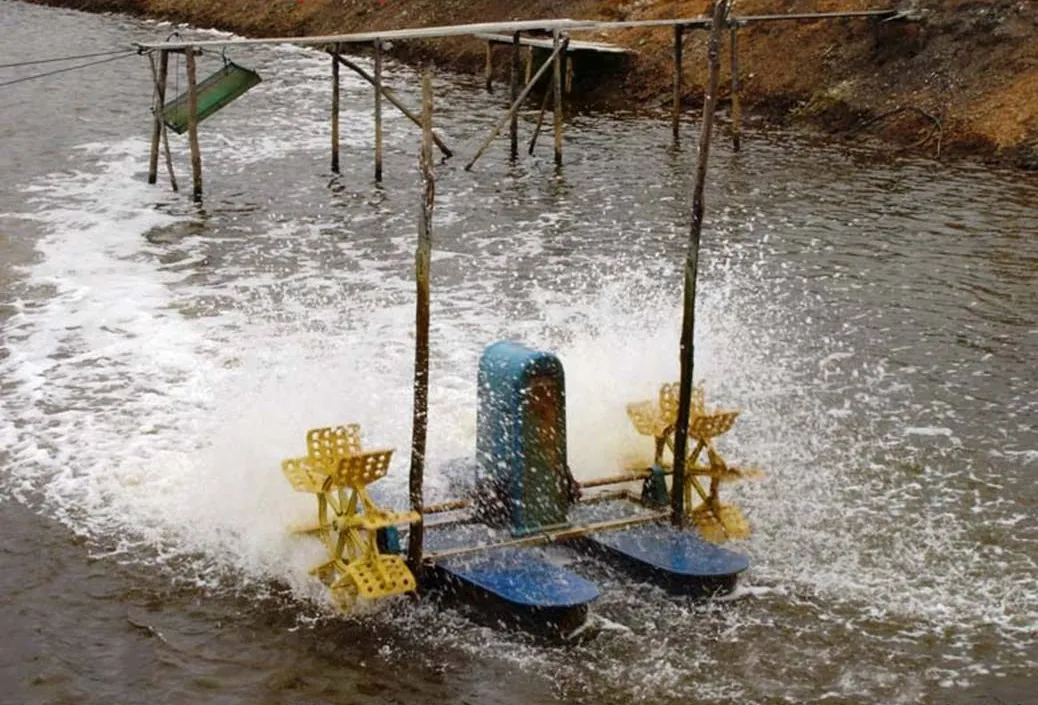
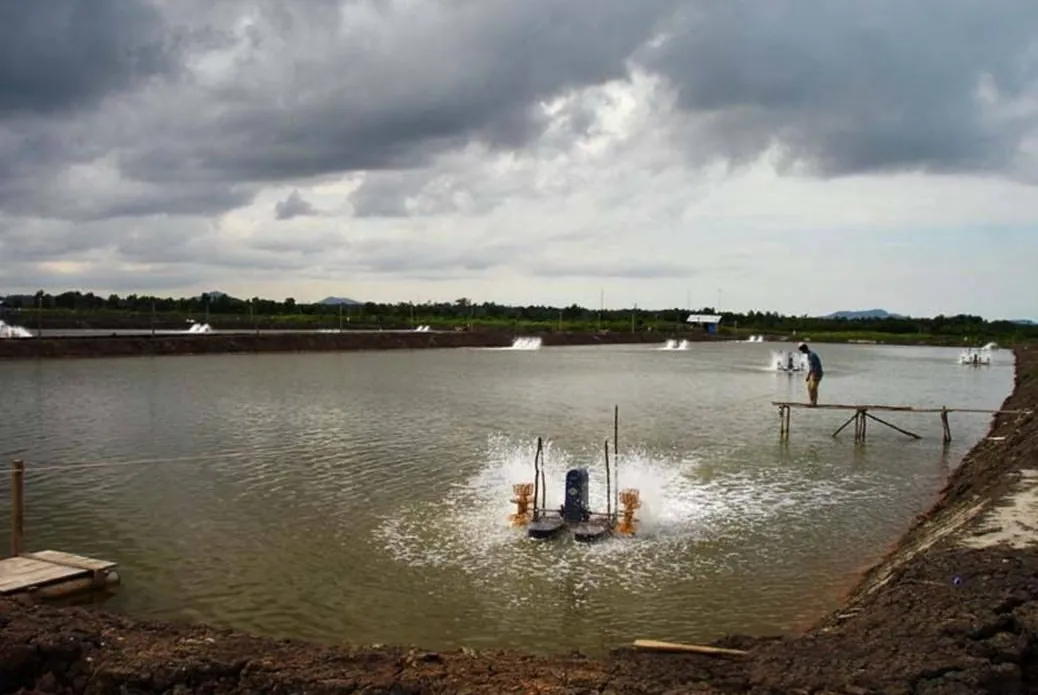
A foul bottom and unstable water are what tip a healthy gut into WFS. Monitor dissolved oxygen, salinity, pH and temperature continuously with a multi-parameter water quality meter — you cannot manage what you do not measure — and hold dissolved oxygen above 4–5 mg/L day and night using a paddle wheel aerator for surface mixing and a dissolved oxygen cone where you need high-efficiency oxygen transfer at depth. Good oxygen and stable water keep the bottom aerobic and the microbiome on your side.
3. Disinfect and filter intake water
EHP spores and Vibrio both ride in on the water, so treat all intake water before it reaches the shrimp:
- Pass it through a UV water sterilizer to knock down free EHP spores and the bacteria that travel with them.
- Screen out carriers and organic debris with an automatic rotary drum filter followed by a biological filter, so polychaetes, other crustaceans and infected tissue never enter the pond.
- Where possible, hold and disinfect water in a reservoir before use rather than pumping straight from a shared canal.
4. Feed clean, and never feed spoiled feed
Feed is one of the most controllable causes of WFS. Use good-quality shrimp feed, store it dry and cool to keep mould and mycotoxins out, match pellet size to the stage, and avoid over-feeding — uneaten feed rots on the bottom and feeds the exact bacteria that drive white feces. Discard any feed that smells off or shows mould.
5. Manage the gut and pond microbiome with probiotics
This is the lever WFS responds to most directly. Aquaculture probiotics — Bacillus and similar strains — suppress the Vibrio that colonises the damaged gut, keep the pond bottom from turning anaerobic, and help rebuild a healthy gut microbiome. Probiotics in feed and in the water are a core part of both preventing WFS and pulling a pond back once white strings appear.
6. Lower density and lock down the farm
High stocking density loads the bottom faster, raises the Vibrio count and spreads EHP — all of which push toward WFS. Where white feces is a recurring problem, stocking lighter pays back. Disinfect nets, boots and harvest gear between ponds, and never move water or equipment from an affected pond to a clean one.
WFS sits in the same family of failures as EHP, vibriosis and the broader set of shrimp farming mistakes and biosecurity gaps: almost every chronic case traces back to the seed, the bottom or the feed — not to something you could have dosed in mid-cycle.
Is white feces syndrome harmful to humans?
No. The organisms behind WFS — EHP, Vibrio and the rest — affect shrimp, not people, and shrimp from an affected pond are safe to eat. They are simply smaller, slower-growing and less profitable. The damage from WFS is purely economic, but a stalled, high-FCR crop can quietly erase a season’s margin.
Frequently asked questions
What is white feces syndrome in shrimp?
White feces syndrome (WFS) is a gut and hepatopancreas disorder of farmed shrimp, named for the white, stringy faeces that float on the pond surface and the white midgut in affected animals. It rarely causes mass mortality but stunts growth, raises the feed conversion ratio and widens size variation.
What causes white feces in shrimp?
WFS is multifactorial. The main drivers are EHP (Enterocytozoon hepatopenaei), Vibrio and other opportunistic bacteria, poor or spoiled feed, and a degraded pond bottom with unstable water. The white strings are sloughed gut cells and aggregated transformed microvilli (ATM), not a worm or parasite.
Is white feces syndrome the same as EHP?
No. EHP is a specific microsporidian parasite; WFS is a syndrome with several possible causes. EHP is one of the most common drivers of WFS, so a pond with white feces should be PCR-tested for EHP — but WFS can also be driven mainly by Vibrio, bad feed and a poor pond bottom.
How do you treat white feces syndrome?
There is no single cure. Act early: cut and adjust feeding, remove spoiled feed, improve the pond bottom and dissolved oxygen, suppress Vibrio and rebuild the gut microbiome with probiotics rather than antibiotics, and PCR-test for EHP. Caught early, ponds often recover feeding and bring FCR back.
How do you prevent white feces in shrimp?
Stock SPF/PCR-negative post-larvae, reset and lime the pond bottom between crops, disinfect and filter intake water, feed only clean unspoiled feed without over-feeding, hold dissolved oxygen above 4–5 mg/L with stable water, and manage the gut and pond microbiome with probiotics.
Is white feces syndrome dangerous to humans?
No. The pathogens behind WFS infect shrimp, not people. Shrimp from an affected pond are safe to eat; they are simply smaller and less profitable. The loss is purely economic.
Put this into practice on your farm
Tell our engineers your species, target density and site — we will size the system and reply within one business day.
More to explore
- What Is Biofloc Technology and How Does It Work?
- Fish Feed Types: Floating vs Sinking Pellets for Aquaculture
- Trichodina in Tilapia: Symptoms, Diagnosis & Control
- Bacterial & Fungal Diseases in Sturgeon: Symptoms & Control
- Columnaris and Parasitic Diseases in Catfish
- Water Quality & Fish Disease: Why Most Outbreaks Start in the Water
Building a system from what you read here? Ask our engineers for a tailored plan →